

Beyond Basic Balls: AI and Jewelry
For years, finding truly unique piercing jewelry has been a frustrating experience. You're often stuck with limited selections at mainstream retailers, or facing hefty price tags for anything remotely custom-made. Hand-making jewelry, or even casting, requires significant skill and time, naturally driving up costs. But things are starting to change. Artificial intelligence is entering the body modification world, and it promises a future where genuinely personalized designs are accessible to more people.
The idea of custom jewelry isn't new, of course. For centuries, skilled artisans have crafted bespoke pieces for clients. However, AI offers a different approach—one built on speed, iteration, and the potential to explore designs beyond the limits of human imagination. We’re not talking about robots replacing jewelers, at least not yet. This is about AI tools empowering both designers and customers to create something truly one-of-a-kind.
The initial excitement around AI-designed jewelry stems from its ability to break down barriers to entry. Previously, commissioning a custom piece meant a significant investment and a lengthy process. Now, AI can generate dozens of design options in minutes, allowing for a level of experimentation never before possible. It's a fascinating shift, and one that's poised to reshape how we think about body adornment.
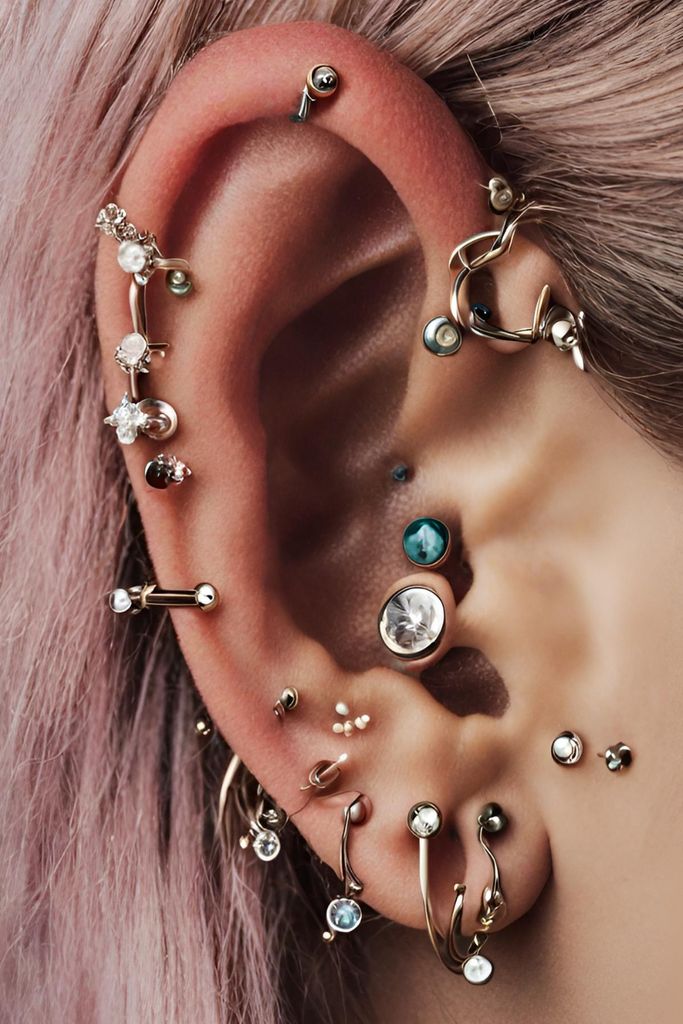
The Design Process: How It Works
At its most basic, AI-driven jewelry design involves feeding a generative AI model with specific parameters and letting it create variations. It’s important to understand that the AI isn't 'thinking' or 'creating' in the human sense; it's identifying patterns and relationships within a massive dataset of jewelry designs. The more detailed the input, the more refined the output will be.
The types of inputs are varied. A user might specify their preferred style – minimalist, ornate, geometric, tribal – or indicate a preference for certain metals like titanium, surgical steel, or gold. Gemstone choices are also key; AI can explore different cuts, colors, and settings. Crucially, the design process can also incorporate anatomical considerations. A user could input details about their ear shape or nostril size, and the AI would generate designs optimized for a comfortable and secure fit.
The initial AI-generated designs are often conceptual, requiring refinement by a human designer. These designers don’t start from scratch; they take the AI’s output and adjust details, ensuring structural integrity, aesthetic appeal, and manufacturability. It’s a collaborative process, blending the creativity of humans with the computational power of AI. This partnership allows for a faster turnaround and a wider range of design possibilities.
The technology relies on generative AI models, algorithms trained on vast datasets of images and designs. While specific SDKs aren’t widely publicized in this emerging field, the underlying principles are similar to those used in other AI-powered design tools. The output isn't a finished product, but a blueprint for creation.
Material Matters: AI & Manufacturing
AI isn't just impacting the design phase; it’s also influencing material selection and manufacturing. AI algorithms can analyze the properties of various materials – biocompatibility, durability, weight, aesthetic qualities – and suggest options based on the user’s preferences and the intended piercing location. This is especially important for those with sensitivities or allergies.
The potential for AI to optimize 3D printing parameters is significant. 3D printing is already a popular method for creating custom jewelry, but it can be wasteful and produce parts with less-than-ideal strength. AI can analyze printing data in real-time, adjusting parameters like laser power, printing speed, and layer thickness to minimize waste and maximize the structural integrity of the finished piece.
AI is also being used in quality control. Computer vision systems can inspect materials and finished jewelry for flaws – cracks, imperfections, inconsistencies in color – that might be missed by the human eye. This helps ensure that only high-quality pieces reach the customer. Furthermore, AI can assist in the exploration of novel materials, such as bioplastics or lab-grown gems, potentially offering more sustainable and ethical options.
Personalization: From Selfies to Septums
The real power of AI in piercing jewelry lies in its ability to deliver a level of personalization previously unattainable. Imagine uploading a selfie and having AI generate jewelry designs that complement your facial features. This isn't just about aesthetics; it's about creating a piece that feels uniquely you.
AI can analyze facial landmarks – the position of your eyes, nose, mouth, and jawline – to identify shapes and proportions that will harmonize with different jewelry designs. For example, someone with a strong jawline might be shown bolder, more geometric pieces, while someone with softer features might be presented with more delicate and flowing designs.
Beyond facial features, AI can account for the anatomy of the piercing itself. Designing jewelry for a helix piercing is different than designing for a nostril or a septum. AI can consider the curvature of the cartilage, the available space, and the need for secure retention to create a piece that fits comfortably and won't easily dislodge. It can even generate designs based on personal stories or memories, translating a significant date into a unique pattern or motif.
Cost Breakdown: AI vs Traditional
The million-dollar question: how does the cost of AI-designed jewelry compare to traditional custom work? The answer, as with most things, is complicated. Several factors influence the price, including the material used, the complexity of the design, the manufacturing method, and whether a human designer is involved in the final refinement process.
Currently, a simple custom piece from Painful Pleasures can range from $50 for a basic design to $200+ for something more intricate, depending on the material and any added gemstones. Body Art Forms offers Prince Albert piercings starting around $70, but fully custom designs can easily exceed $300. AI-designed jewelry may not always be cheaper upfront, especially if it requires significant human intervention, but it can offer more value for the price.
AI can reduce design costs by automating much of the initial concept generation. This can translate into lower prices for customers, or allow designers to spend more time on refining and perfecting the designs. The potential for AI to optimize manufacturing processes, reducing waste and improving efficiency, could also contribute to lower costs in the long run. However, early adoption of this technology will likely come with a premium.
Comparison of Piercing Jewelry Options - 2026
| Price Range | Customization Level | Design Time | Material Options | Complexity of Design |
|---|---|---|---|---|
| $10 - $200+ | Limited to existing stock designs and sizes | Immediately available | Common metals: Surgical Steel, Titanium, Acrylic | Simple shapes, standard gem cuts |
| $100 - $1000+ | Moderate - alterations to existing designs, some gemstone choices | 2-8 weeks, depending on jeweler workload | Wide range: Gold (various karats), Platinum, Silver, Titanium, Gemstones | Moderate - can accommodate some complex shapes and settings |
| $50 - $500+ | High - fully bespoke designs generated via AI, iterative refinement possible | Hours to days, depending on refinement requests and fabrication method | Dependent on fabrication technology - likely similar to traditional custom options, potentially including newer alloys | Very High - AI can generate intricate and organic designs beyond traditional limitations |
| $30 - $150 | Minimal - selection from pre-designed options with limited variation | Immediately available | Primarily Surgical Steel, some Titanium | Basic, geometric shapes |
| $200 - $800+ | Significant - choice of metal, stone, and basic shape modifications, often through a jeweler's design software | 1-4 weeks | Gold, Silver, Titanium, Gemstones | Moderate - allows for some detailed work but limited by traditional techniques |
| $75 - $600+ | Extensive - AI-driven design with user input, allowing for unique and personalized creations | 1-7 days, including fabrication | Wide range, including biocompatible materials | High - capable of generating complex, organic, and highly detailed designs |
Illustrative comparison based on the article research brief. Verify current pricing, limits, and product details in the official docs before relying on it.
Helix, Nostril, & Beyond: Piercing-Specific Designs
AI’s ability to tailor designs to specific piercing types is a game-changer. A helix piercing, for example, requires jewelry that is lightweight and comfortable, with a design that won't snag on hair. AI can generate options with curved shapes and smooth surfaces, optimizing for both aesthetics and functionality.
Nostril piercings present different challenges. The jewelry needs to be secure, but not overly bulky. AI can create designs that follow the natural curve of the nostril, minimizing irritation and maximizing comfort. Septum jewelry requires careful consideration of the septum’s anatomy, and AI can generate designs that fit snugly without causing discomfort.
For daiths, AI can focus on creating designs that complement the natural curve of the cartilage, avoiding pressure points and ensuring a secure fit. Even for more unusual piercings, like industrial or rook piercings, AI can generate designs that are both aesthetically pleasing and anatomically sound.
What About the Future?
The future of AI in piercing jewelry is brimming with possibilities. We can anticipate seeing AI-powered 'try-on' apps that allow customers to virtually visualize jewelry on their bodies before making a purchase, eliminating the guesswork and reducing the risk of returns. These apps could use augmented reality to overlay the jewelry onto a live video feed of the user.
AI could also be used to predict which designs will be most popular, helping jewelers optimize their inventory and reduce waste. This predictive capability could also be used to personalize marketing efforts, showing customers designs that are likely to appeal to their individual tastes. The evolution of materials is also likely to be influenced by AI, potentially leading to the development of new biocompatible and sustainable options.
Looking further ahead, we might see 'living' jewelry – pieces that change color or shape in response to the wearer’s mood or environment. This could be achieved through the use of smart materials and embedded sensors. However, with these advancements come ethical considerations. Data privacy – how is the data collected from selfies and anatomical scans being used? – and algorithmic bias – are certain designs being favored over others based on discriminatory factors? – are important questions that need to be addressed.
Ultimately, AI has the potential to democratize access to custom piercing jewelry, empowering individuals to express their unique style and personality. It’s a thrilling development, and one that promises to reshape the body modification landscape in the years to come.
Would you be willing to use AI to design your next piercing jewelry?
AI-powered design tools are making waves in the custom piercing jewelry space, offering new possibilities for personalization and precision. We want to hear from you — as a member of the Piercing Pals community, how do you feel about incorporating artificial intelligence into your next jewelry design? Vote below and share your thoughts!

No comments yet. Be the first to share your thoughts!